Old Lady-Day
Tess of the d'UrbervillesOld Lady-Day is the traditional date on which agricultural service agreements take effect and rural households move between farms. In the novel it marks both Tess’s temporary foothold as a field worker and the forced removal of her family from Marlott: a calendar threshold that converts economic vulnerability into displacement, while placing private hardship within wider changes in rural life.
The agricultural calendar
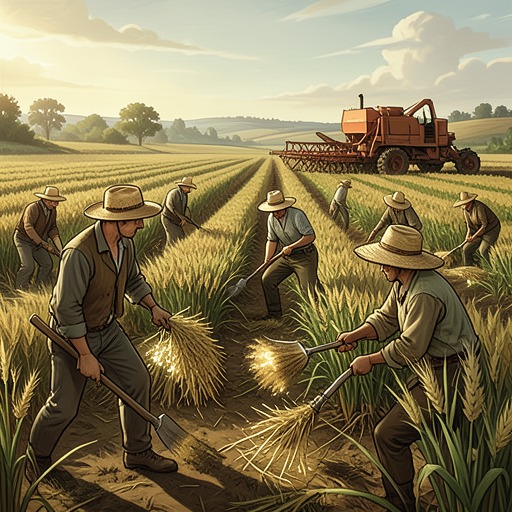
The eve of Old Lady-Day brings the agricultural world into a characteristic fever of movement. Agreements for outdoor service, made at Candlemas for the coming year, are now carried out; workers who have chosen not to remain in their former places move to new farms. The date therefore does more than mark a point in the year: it coordinates hiring, transport, and household removal, making individual lives answer to a shared labor calendar.
The narrative emphasizes that the custom has changed over time. When Tess’s mother was a child, most field workers stayed on a single farm throughout their lives, often following the same attachment as their parents and grandparents. By the period described, annual moves had become increasingly common, especially among younger families, for whom a new farm could promise excitement or improvement. Yet the promise was unstable: a household’s former home, figured as Egypt, might appear to another family as a Land of Promise, only to become Egypt in turn once they lived there. Repeated relocation makes hope and disappointment part of the same cycle.
Tess’s precarious employment
At the farm where Marian has brought her, Tess waits until the workers have received their wages before being introduced. The farmer is away, but his wife agrees to hire her on the condition that she remain until Old Lady-Day. Tess signs the agreement, securing work only for a defined period. The arrangement is shaped by the limited demand for women’s field labor: such work is seldom offered, but women’s lower wages make them profitable for tasks they can perform as readily as men.
The employment offers no abundance. Tess finds lodging in the house whose gable wall had given her shelter from the cold, and the prospect she has secured amounts to poor subsistence and a roof through the winter. That night she writes to her parents with her new address in case a letter from Angel should arrive at Marlott. She withholds how sorry her circumstances are, fearing that an account of them might bring reproach upon her husband. The term of her agreement thus stands between her immediate need for shelter and work and the family emergency that soon makes waiting untenable.
When 'Liza-Lu arrives with news that their mother is gravely ill, that the doctor expects her to die, and that their father is also unwell, Tess decides she must go home. Her agreement does not expire until Old Lady-Day, the sixth of April, but because the remaining interval is short she resolves to risk leaving early. She asks Marian and Izz to make the best of her case to the farmer, gives 'Liza-Lu supper, tucks her into her own bed, packs what she can carry in a withy basket, and sets out that night, telling her sister to follow the next morning. The calendar has fixed the end of Tess’s hired term, but family necessity forces her to cross that boundary before it arrives.
A date of expulsion
Old Lady-Day also exposes the structural pressures remaking village life. Annual migration is increasing, but it is only one cause of change. Marlott is losing the more stable class of tradespeople and small holders who once lived alongside agricultural laborers: carpenters, smiths, shoemakers, and other workers whose livelihoods and local standing rested on long leases, copyholds, or small freeholds. As those holdings fall in, their cottages are rarely let again to similar tenants; some are demolished, while others are reserved for the farmer’s workers. Families whose trades depend on village inhabitants are pushed to follow them toward larger towns. The narrator pointedly undercuts the statistical phrase for this movement, describing it instead as water being made to flow uphill by machinery.
The contraction of housing leaves surviving cottages in demand for agricultural employees. The Durbeyfield household is already regarded as removable when its lease ends, and on the first Lady-Day when it can be expelled, its roomy house is required for a carter with a large family. The family’s precarious position is intensified by the village’s moral judgment: Tess’s return has drawn notice, and the household is treated as one that ought to go in the interests of local respectability. Old Lady-Day is consequently not a neutral administrative deadline. It is the date when housing need and social exclusion converge to make the family’s removal enforceable.
The removal journey
The night before the move, while drizzle blurs the sky, Tess keeps house as her mother, 'Liza-Lu, and Abraham go to say goodbye to friends. By the small hours, rumbling wagons and teams begin passing along the highways. These are the preparations for the general removal: farmers’ vehicles collect the belongings of workers they have hired, reaching departing households by six in the morning so loading can begin. The customary system provides transport for a hired man moving to the farm that needs his service; it does not provide the same assistance to Tess and her family. They are women, not regular laborers, and not especially wanted anywhere, so they must hire a wagon at their own expense.
The morning is windy and threatening, but the rain holds off, a relief because a wet Lady-Day would leave furniture, bedding, and clothing damp and bring further hardship. The family eats breakfast in thin light and begins clearing the house, with a neighbor or two helping. Beds and bedding are arranged in a circular nest so Joan and the younger children can sit among them. After a long wait for the horses, the wagon finally moves at about two o’clock. The cooking pot swings from its axle; Joan rides with the clock’s head in her lap, protecting its mechanism as the clock strikes in hurt, irregular tones over the jolts. Tess and her next eldest sister walk beside the load until they are out of the village.
On the sixth of April, their wagon meets many others carrying migrating families. Each load follows a familiar arrangement, with the family dresser placed upright at the front above the shaft horses. Its shining handles and marks of domestic use make it resemble an object the family is bound to carry with reverence. The procession gives the date a public, collective scale, but the Durbeyfields’ experience remains distinct: they travel without a farmer’s hired conveyance, bearing their belongings and household history on a wagon they have had to pay for themselves. Old Lady-Day gathers the movement of rural families into a single scene while exposing how differently its costs are distributed.
Meaning and consequences
The date joins two forms of insecurity in Tess’s life. At the farm it sets the limit of a poor but necessary job; at Marlott it becomes the occasion on which the Durbeyfields lose their home. The contrast is stark: the same calendar that organizes paid employment for agricultural workers supplies no automatic protection to women and dependents who are neither securely hired nor wanted as tenants. Tess’s early departure from her agreement and the family’s compelled departure from the village are distinct actions, but both reveal how little control they possess over the conditions of shelter and work.
The moving season also places the family’s immediate crisis within a larger rural transformation. Long-established village households and local trades are disappearing as cottages are demolished or reserved for farm labor, while workers increasingly move from place to place in search of employment. The repeated exchange of one household’s Egypt for another’s Land of Promise turns the ritual of relocation into an image of unstable hope. For the Durbeyfields, however, Old Lady-Day offers no promised destination: it marks the passage from a home they have lost to an uncertain search for somewhere else to live.